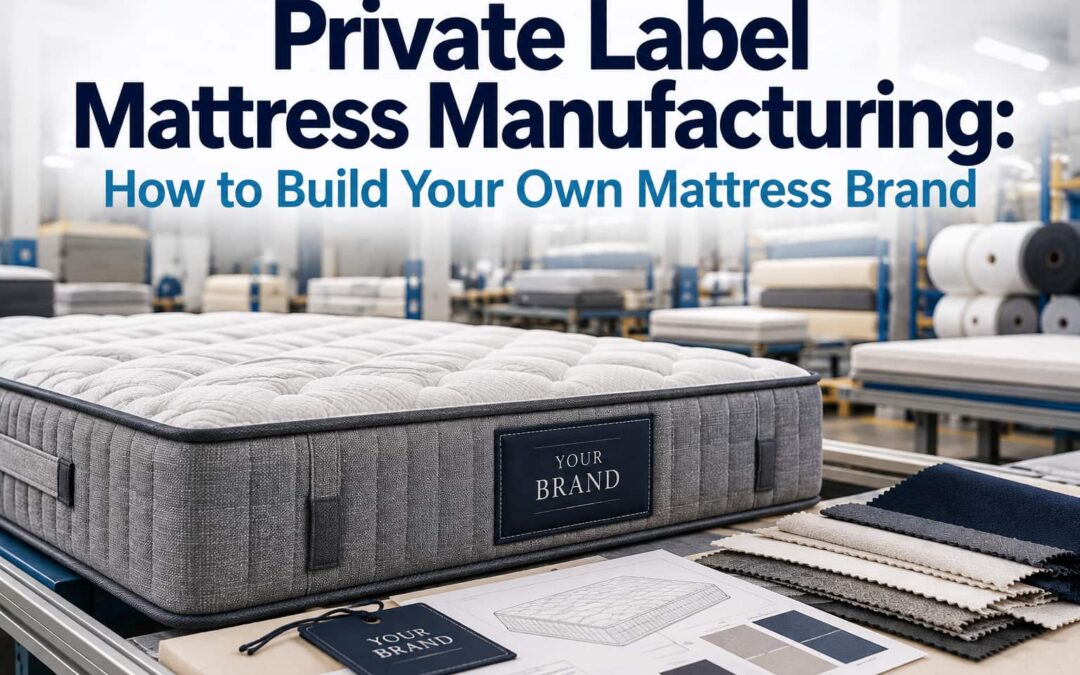
private label mattress manufacturer
Launching your own mattress brand doesn’t necessarily mean building a factory, purchasing manufacturing equipment, or developing an entire production operation from scratch. Private label mattress manufacturing allows retailers, entrepreneurs, hospitality companies, and other businesses to offer mattresses under their own brand while working with an established mattress manufacturer.
The key is understanding what private label manufacturing actually includes. Product construction, minimum orders, customization, branding, production capacity, quality consistency, and lead times can all influence whether a private label mattress program is right for your business. Businesses should also consider applicable product safety requirements, and the U.S. Consumer Product Safety Commission (CPSC) provides information about consumer product safety and applicable requirements.
What Is Private Label Mattress Manufacturing?
Private label mattress manufacturing is an arrangement in which a mattress manufacturer produces mattresses that another business sells under its own brand.
Instead of purchasing a nationally recognized mattress and reselling it under the manufacturer’s name, the business can develop its own product identity.
Depending on the manufacturing program, customization may include:
- Mattress construction
- Firmness
- Comfort layers
- Foam configurations
- Coil systems
- Mattress height
- Fabrics
- Labels
- Model names
- Packaging
- Branding
However, private label does not automatically mean that every component of a mattress can be customized.
The level of customization depends on the manufacturer, production capabilities, order volume, materials, and specifications.
That is one of the first things businesses should clarify when evaluating a private label mattress manufacturer.
Private Label vs. White Label Mattresses
Private label and white label are often used interchangeably, but there can be an important difference.
A white label mattress is typically an existing mattress design that a business can sell using its own branding.
A private label mattress may offer greater customization of the product itself.
Here’s a simplified comparison:
| Feature | White Label | Private Label |
|---|---|---|
| Existing mattress design | Common | Possible |
| Custom branding | Yes | Yes |
| Custom labels | Usually | Usually |
| Construction changes | Limited | Potentially available |
| Custom comfort options | Limited | Potentially available |
| Development time | Generally shorter | Can require more planning |
| Brand differentiation | Moderate | Potentially higher |
Exact definitions and capabilities vary between manufacturers, so businesses should always confirm what a particular program includes.
Why Businesses Create Their Own Mattress Brands
One of the biggest advantages of private label manufacturing is brand control.
When customers purchase a nationally distributed mattress brand, they can often find the same or similar product from multiple retailers.
That makes price comparison easy.
A private label mattress gives the retailer an opportunity to create a more distinctive product offering.
Instead of selling only another manufacturer’s brand, you’re building equity in your own.
This can be particularly attractive for:
- Mattress retailers
- Furniture stores
- E-commerce businesses
- Regional retail chains
- Hospitality suppliers
- Property management companies
- Interior design businesses
- Entrepreneurs entering the sleep-products market
The appropriate strategy depends on the business and its customers.
Step 1: Identify Your Target Customer
Before designing a mattress, determine who you’re designing it for.
This sounds simple, but it’s one of the most important decisions in private label development.
Ask:
Who is going to buy this mattress?
What price range are they shopping in?
What type of comfort are they expecting?
Where will the mattress be sold?
What alternatives will customers compare it against?
A retailer targeting value-conscious consumers may require a completely different product strategy from a boutique brand targeting premium buyers.
Similarly, mattresses designed for hotels, rental properties, student housing, or other commercial environments can have different requirements.
Start with the customer, not the mattress.
Step 2: Define Your Product Line
You don’t necessarily need ten mattress models to launch a mattress brand.
In fact, too many options can complicate inventory and confuse customers.
A simpler collection might include:
Firm
Medium
Plush
Or products may be differentiated by construction, price point, mattress height, or another meaningful characteristic.
The important question is whether each model serves a clear purpose.
If two mattresses are nearly identical, customers may struggle to understand why both exist.
A focused collection can make purchasing easier while simplifying inventory management.
Step 3: Determine Mattress Construction
Once the target customer and product positioning have been established, the physical mattress needs to be developed.
Depending on the manufacturer’s capabilities, decisions may include:
Support System
The mattress may use an innerspring system, individually wrapped coils, foam support core, or another construction.
Comfort Layers
Different cushioning materials and configurations can influence pressure distribution, responsiveness, and surface feel.
Transition Materials
Some constructions use transition layers between the comfort system and support core.
Edge Construction
The mattress perimeter may use additional reinforcement depending on the product design.
Quilting and Cover
Fabric, quilting materials, stitching, and overall appearance contribute to both presentation and surface feel.
The goal shouldn’t be to simply add as many components as possible.
Every layer should have a reason for being there.
Step 4: Create Meaningful Product Differentiation
This is where many new mattress brands can make a mistake.
They focus heavily on creating:
A logo.
A name.
A beautiful website.
Premium packaging.
Those things matter—but they aren’t the product.
A strong private label mattress needs a clear reason for existing.
Perhaps the product offers a particular comfort profile.
Maybe the collection provides straightforward choices at clearly defined price levels.
Perhaps it is designed for a specific commercial application.
Whatever the strategy, differentiation should go beyond the label attached to the mattress.
Branding can attract the first purchase. Product experience influences what customers think afterward.
Step 5: Develop Your Mattress Branding
Once the product strategy is established, branding can bring the collection together.
This may include:
- Brand name
- Logo
- Mattress model names
- Product labels
- Color palette
- Packaging
- Product descriptions
- Photography
- Website presentation
- Retail signage
Product names should also be easy for customers and salespeople to understand.
Complicated names may sound sophisticated, but they can make products harder to remember.
Strong mattress branding should make the collection easier to understand—not harder.
Step 6: Understand Minimum Order Quantities
Private label mattress manufacturing frequently involves minimum order quantities, or MOQs.
This is important because customization can require materials, production preparation, labels, packaging, and other manufacturing considerations.
Before committing to a private label program, ask:
- What is the minimum initial order?
- Is the minimum calculated per model?
- Is it calculated per mattress size?
- Can different models or sizes be combined?
- Are reorder minimums different?
- Do customized components have separate minimums?
Understanding these requirements is essential for inventory planning.
Step 7: Calculate the Real Cost of Your Mattress Program
The manufacturing cost of the mattress isn’t necessarily the only expense.
Businesses should consider the broader economics of launching a mattress line.
Potential expenses may include:
- Mattress manufacturing
- Custom labels
- Packaging
- Freight
- Warehousing
- Product photography
- Website development
- Marketing
- Advertising
- Showroom samples
- Returns
- Warranty administration
- Customer service
This gives you a much more realistic understanding of the investment required.
Step 8: Plan Inventory Carefully
Inventory can become one of the largest financial commitments for a mattress business.
Consider what happens when one mattress model is offered in multiple sizes.
A single product might be available as:
- Twin
- Twin XL
- Full
- Queen
- King
- California King
Now multiply those sizes across several mattress models.
Inventory requirements can grow quickly.
This is another reason a focused initial product line can be beneficial.
Start with products and sizes supported by actual demand rather than trying to cover every possible customer immediately.
Step 9: Discuss Production Lead Times
Before launching, understand how long production and replenishment can take.
Ask your manufacturer:
How long does an initial production run typically take?
How long do reorders take?
Can production time change during busy periods?
How far ahead should large orders be placed?
What happens if a particular material becomes temporarily unavailable?
Your marketing strategy should align with your ability to maintain inventory.
Generating demand for a product you can’t replenish creates a different problem.
Step 10: Make Quality Consistency a Priority
A private label mattress represents your brand.
Customers don’t see the manufacturer behind the scenes.
They see your company’s name on the product.
That makes manufacturing consistency particularly important.
If a customer tries a mattress in your showroom and later receives a product that feels noticeably different, that inconsistency becomes your problem.
Businesses should discuss how specifications are documented and maintained across production runs.
Ask the manufacturer about quality-control procedures and how product consistency is managed.
Private Label Mattress Development Checklist
Before moving forward, use this checklist:
| Decision | Question to Answer |
|---|---|
| Target Market | Who will buy the mattress? |
| Price Position | Value, mid-range, premium or another segment? |
| Product Line | How many models are necessary? |
| Comfort | Firm, medium, plush or multiple options? |
| Construction | What support and comfort systems will be used? |
| Branding | How will the product be presented? |
| MOQ | How much inventory must be purchased? |
| Production | How long will manufacturing take? |
| Shipping | How will products reach your business? |
| Inventory | Where will mattresses be stored? |
| Quality Control | How will consistency be maintained? |
| Reorders | How quickly can successful products be replenished? |
Answering these questions before production begins can prevent expensive decisions later.
Questions to Ask a Private Label Mattress Manufacturer
Before choosing a manufacturing partner, ask:
- What private label options do you offer?
- Which mattress components can be customized?
- What are your minimum order quantities?
- Can different mattress sizes be combined within an order?
- What mattress constructions do you manufacture?
- What firmness options are available?
- Can labels or branding be customized?
- What are typical production lead times?
- How are repeat orders handled?
- How do you maintain product consistency?
- What shipping or delivery options are available?
- Can production scale if our sales increase?
Clear answers to these questions will help you compare manufacturers more effectively.
Should You Start With One Mattress or an Entire Collection?
More products don’t automatically create a stronger brand.
For a new business, launching a smaller collection can provide valuable information about what customers actually want.
For example, instead of immediately launching nine mattress models, a business could start with a carefully selected collection covering its primary customer segments.
Actual sales data can then guide future product development.
This approach can help reduce inventory risk while allowing the brand to evolve based on real customer demand.
Your Manufacturer Is Part of Your Brand Strategy
Private label mattress manufacturing isn’t simply a purchasing decision.
It’s a partnership.
Your manufacturer influences:
- Product quality
- Product consistency
- Available specifications
- Production capacity
- Replenishment
- Customer experience
That’s why businesses should evaluate a manufacturing partner based on more than the lowest price.
The objective is to develop products customers want to purchase while creating a manufacturing relationship capable of supporting the brand as it grows.
Build Your Mattress Brand With United Bedding
If you’re exploring mattress manufacturing, wholesale mattress opportunities, or private label possibilities, United Bedding can help you learn more about available options.
A successful mattress brand begins with the right product strategy and a manufacturing relationship that understands the importance of quality, consistency, and dependable production.
Contact United Bedding to discuss your business and mattress needs.
Contact United Bedding
United Bedding
Website: www.unitedbedding.com
Tel: 908-668-0220
Fax: 908-668-4870
Email: unitedbed@gmail.com