A mattress may look simple from the outside, but underneath the fabric is a carefully designed system of materials, support components, comfort layers, and finishing details. The mattress manufacturing process involves selecting and combining these components so they work together to provide comfort, support, stability, and long-term performance. The U.S. Consumer Product Safety Commission (CPSC) provides information on mattress safety requirements and standards, giving consumers, retailers, and manufacturers a useful reference for understanding important mattress requirements.
Understanding how mattresses are made can also help retailers, hospitality businesses, and consumers recognize why two mattresses that look similar on the showroom floor can perform very differently.
At United Bedding, we believe understanding what goes into a mattress is one of the best ways to understand its quality.
What Is the Mattress Manufacturing Process?
The mattress manufacturing process generally involves designing the mattress, selecting materials, preparing the support system, adding comfort and transition layers, creating the quilted cover, assembling the components, closing the mattress, and inspecting the finished product.
However, mattress manufacturing isn’t simply about stacking layers together.
Each component needs a specific purpose within the finished mattress.
A well-designed mattress balances several characteristics:
- Support
- Comfort
- Pressure distribution
- Stability
- Edge performance
- Durability
- Consistency
The exact materials and construction methods vary depending on the type of mattress being manufactured.
Step 1: Designing the Mattress
Before materials are assembled, manufacturers need to determine what the mattress is designed to accomplish.
Is it intended to have a plush feel?
Medium firmness?
A firmer sleeping surface?
Does the design require coils, foam, or a combination of the two?
These decisions affect virtually everything that follows.
Mattress design requires manufacturers to think about the finished product as a complete sleep system rather than a collection of individual materials.
Adding a softer comfort layer, for example, doesn’t affect only softness. It can influence how deeply a sleeper settles into the mattress and how the support layers underneath are experienced.
That’s why mattress engineering begins before the first layer is assembled.
Step 2: Building the Support System
The support core provides much of the structural foundation of a mattress.
Depending on the mattress design, this can include an innerspring system, individually wrapped coils, foam, or another engineered support structure.
Innerspring and Coil Systems
Coils have been used in mattresses for generations, but not all coil systems are identical.
Different designs can influence:
- Support
- Responsiveness
- Motion transfer
- Airflow
- Edge stability
- Weight distribution
One common mistake consumers make is comparing mattresses primarily by coil count.
A larger number doesn’t automatically indicate a superior mattress.
Coil design, gauge, configuration, mattress dimensions, surrounding materials, and overall construction all need to be considered.
The better question isn’t simply:
“How many coils are inside?”
It is:
“How is the support system designed to work with the rest of the mattress?”
Step 3: Adding Edge Support
The perimeter of a mattress deserves more attention than it usually receives.
Edge support helps stabilize the outer areas of the sleeping surface.
This becomes particularly noticeable when someone:
- Sits on the side of the bed
- Gets into or out of bed
- Sleeps close to the mattress edge
- Shares the mattress with another person
Depending on the mattress design, manufacturers may use reinforced coils, foam encasements, or other construction techniques around the perimeter.
Good edge construction can help make more of the mattress surface practically usable.
Step 4: Selecting and Preparing the Comfort Layers
Above the support system are the layers responsible for much of the mattress’s cushioning and surface feel.
Depending on the product, these may include different types and combinations of foam, fibers, and other cushioning materials.
This is another area where consumers should look beyond marketing terminology.
Two mattresses may both advertise “foam comfort layers” while using substantially different materials, thicknesses, specifications, and configurations.
Those differences can affect:
- Initial feel
- Responsiveness
- Pressure distribution
- Body contouring
- Temperature characteristics
- Long-term performance
More Foam Doesn’t Automatically Mean Better
This is an important distinction.
Mattress quality isn’t determined by how many layers can be listed on a product description.
Every layer should have a purpose.
A properly designed comfort system should complement the support structure underneath it rather than simply increase mattress height.
Step 5: Creating Transition Layers
Some mattress designs include transition materials between the upper comfort system and lower support core.
Why?
Because moving directly from a very soft material to a much firmer support system may create a different feel than the manufacturer wants.
A transition layer can help create a more progressive change between cushioning and support.
Think of the mattress as a suspension system.
The upper layers provide immediate cushioning while deeper components increasingly contribute structural support.
How smoothly those characteristics interact can influence the overall sleeping experience.
Step 6: Quilting and Creating the Mattress Cover
The outside of a mattress isn’t merely decorative.
The cover is the part consumers see and touch first, while quilting can contribute to the initial surface feel.
Depending on the mattress design, quilting may combine fabric with cushioning or fiber materials.
Manufacturers must consider factors such as:
- Fabric construction
- Surface texture
- Cushioning
- Stitching pattern
- Durability
- Overall appearance
A mattress cover should complement the construction underneath it.
An attractive fabric can improve presentation, but appearance alone doesn’t determine mattress quality.
Step 7: Assembling the Mattress
Once the individual components have been prepared, they need to be assembled according to the mattress specifications.
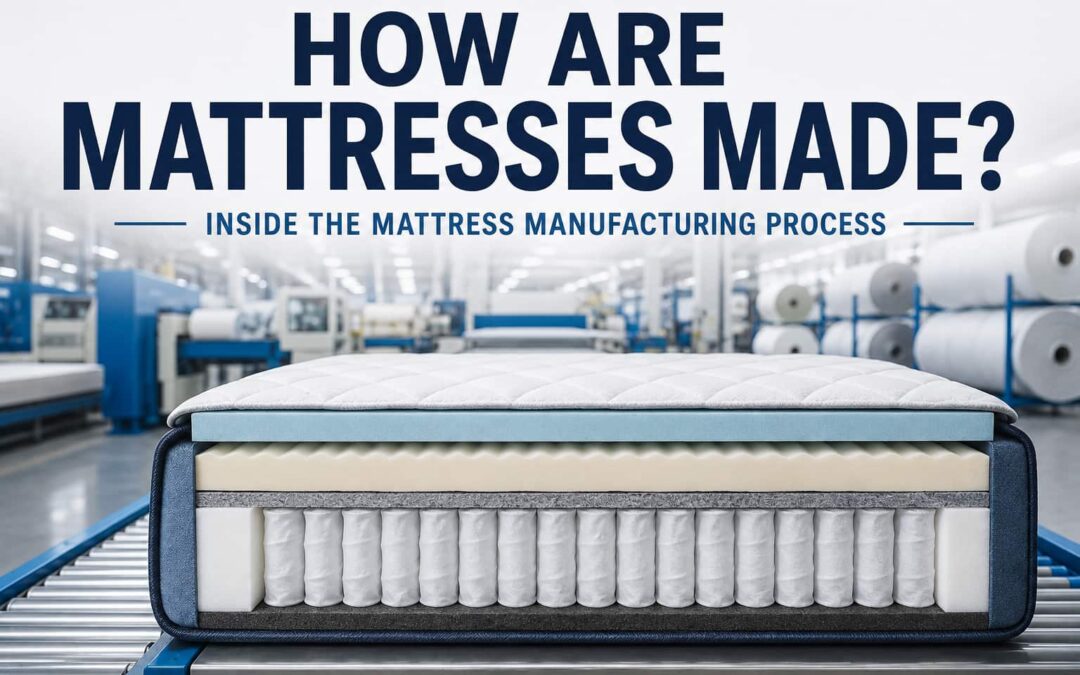
A simplified mattress construction might look like this:
| Layer | Primary Function |
|---|---|
| Cover & Quilting | Surface feel and finishing |
| Comfort Layer | Cushioning and pressure distribution |
| Secondary Comfort Layer | Additional comfort or responsiveness |
| Transition Layer | Connects comfort and support |
| Support Core | Structural support |
| Edge System | Perimeter stability |
| Base | Foundation for the internal construction |
Not every mattress contains these exact layers, and some products use several materials within one category.
The important factor is how the complete construction works together.
Step 8: Closing and Finishing the Mattress
After the internal components are assembled, the mattress needs to be finished and secured.
The exact manufacturing method varies by mattress design.
This stage can involve attaching the cover, closing the mattress perimeter, finishing seams, inspecting stitching, and ensuring that the finished dimensions and appearance meet specifications.
These details may seem cosmetic, but manufacturing consistency matters.
A quality mattress should not only perform correctly; it should also be constructed consistently from one unit to the next.
Step 9: Quality Control
Quality control is one of the most important—and least visible—parts of mattress manufacturing.
Customers typically see only the finished product.
They don’t see the material preparation, assembly, measurements, stitching, finishing, or inspections that happened beforehand.
Quality-control procedures can help manufacturers identify problems before a mattress reaches the customer.
Depending on the manufacturer’s procedures and product specifications, inspections may evaluate areas such as:
- Dimensions
- Construction
- Stitching and seams
- Surface appearance
- Material placement
- Edge construction
- Overall workmanship
This is one reason the manufacturer behind the mattress matters.
What Makes One Mattress Better Than Another?
There isn’t one specification that answers this question.
A mattress shouldn’t be considered superior simply because it has:
More coils.
More foam.
More layers.
More inches of height.
The relationship between the components is more important.
For example, increasing the thickness of a comfort layer may change how the support system underneath feels. Changing the support system may require different transition or comfort materials.
Mattress manufacturing is therefore about balance.
The goal isn’t necessarily to maximize every component. It’s to select appropriate components and make them work together.
Why Can Two Similar-Looking Mattresses Feel Completely Different?
Walk through a mattress showroom and you’ll see products that appear remarkably similar.
Two mattresses might have approximately the same height, similar-looking covers, and even similar descriptions.
Lie on them, however, and they can feel completely different.
The explanation is underneath the fabric.
Differences in foam specifications, layer thickness, coil construction, quilting, transition materials, edge systems, and overall design can dramatically change the finished mattress.
This is why judging a mattress primarily by appearance can be misleading.
How Can Buyers Evaluate Mattress Manufacturing Quality?
Before choosing a mattress or mattress supplier, ask more detailed questions.
Mattress Manufacturing Checklist
☐ Who manufactures the mattress?
☐ What type of support system does it use?
☐ What materials are used in the comfort layers?
☐ How is the perimeter supported?
☐ What purpose does each major layer serve?
☐ How does the manufacturer maintain consistency?
☐ What quality-control procedures are performed?
☐ What warranty supports the finished product?
☐ What does that warranty actually cover?
These questions provide much more useful information than simply asking how thick a mattress is.
Mattress Manufacturing Is About the Complete System
Perhaps the biggest misconception about mattress manufacturing is that one premium-sounding component can determine the quality of the entire mattress.
It can’t.
A mattress is a system.
The cover affects the surface experience. Comfort materials influence cushioning. Transition layers help manage the relationship between comfort and support. The support core provides structure. Edge construction influences perimeter stability.
The quality of the finished mattress depends on how effectively these components work together.
That is why understanding mattress construction is valuable for anyone comparing mattresses, sourcing products, or choosing a mattress manufacturer.
Work With United Bedding
At United Bedding, we understand the importance of thoughtful mattress construction and manufacturing.
Whether you’re researching mattress construction, evaluating products, or looking for information about mattress manufacturing, our team is available to discuss United Bedding and our products.
Contact United Bedding
United Bedding
Website: www.unitedbedding.com
Tel: 908-668-0220
Fax: 908-668-4870
Email: unitedbed@gmail.com